Building Friendships: How Children Learn to Connect, Share and Belong
Published on September 14, 2026
When a child starts nursery or moves into a new room, parents naturally wonder about their happiness, routine, and care. Yet one question often sits closest to a parent’s heart: Will my child make friends?
Forming relationships is a key milestone in early childhood. Building on how we nurture social skills at Thrive, early peer connections teach young children how to negotiate, show empathy, and feel a true sense of belonging. However, making friends is not an instinct that appears overnight. It is a complex set of skills that children learn through daily practice, guided by supportive adults.
The Journey from Playing Beside to Playing Together
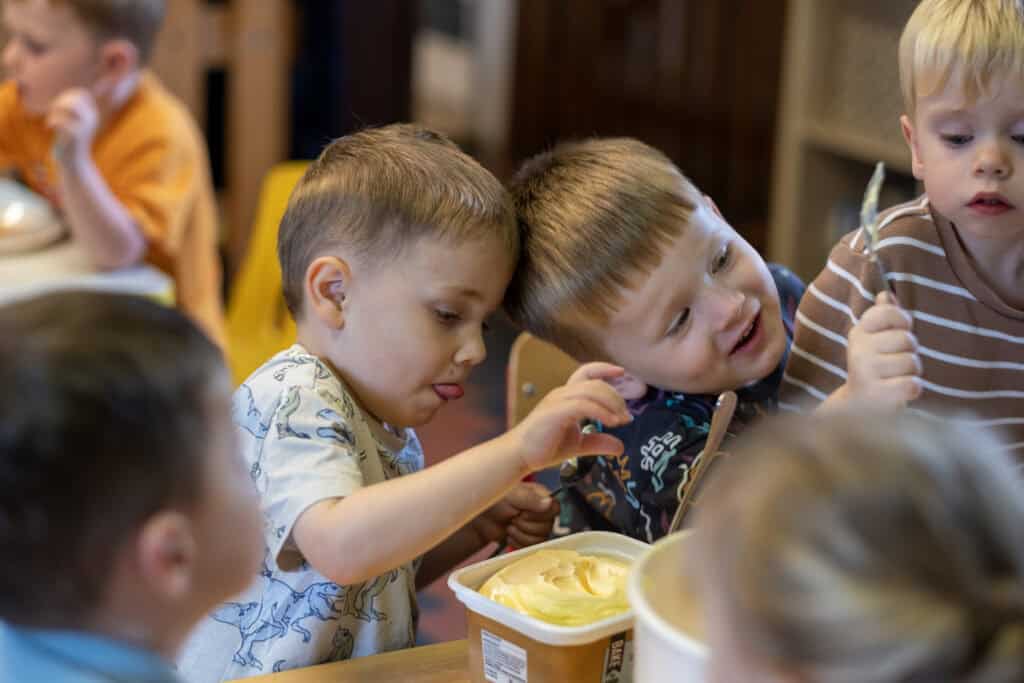
Parents are sometimes concerned when they see young toddlers sitting side by side without directly playing together. This is entirely normal and represents a key developmental stage known as parallel play.
- Solitary Play (Babies): Infants explore their immediate environment independently, observing others from a comfortable distance.
- Parallel Play (Toddlers): Children play alongside one another with similar toys. While they may not interact directly, they are observing peers, learning social cues, and gaining comfort in group settings.
- Associative Play (Young Preschoolers): Children begin to interact, sharing resources and talking about their activity, though their individual play goals may still differ.
- Cooperative Play (Preschoolers): Children work together towards a common goal, taking on roles in imaginative scenarios and negotiating rules.
Whether your child is preparing for nursery for the first time or settling into a new room, understanding these stages helps set realistic expectations for their social progress.
Every Child Follows Their Own Path
While these stages offer a helpful guide, they are not a timetable. Children move through them at their own pace, and some will take a different route entirely. This is particularly true for children with additional needs, who may find aspects of social interaction more challenging, or who connect with others in ways that look different from the descriptions above.
Connection is not always obvious from the outside. A shared glance, contentedly playing near a familiar peer, or returning again and again to the same game with the same child are all genuine friendships in the making.
Every child is supported as an individual, with practitioners working closely with families to build on each child’s strengths and offer the right support at the right time. Progress is celebrated in small steps, and every step counts.
Bumps in the Road: Common Early Social Challenges
Learning to share a space, a toy, or a favourite practitioner inevitably leads to occasional friction. These minor conflicts are not failures in behaviour; they are essential learning opportunities.
Sharing and Possession Young children view their world egocentrically. When a child holds onto a wooden train, they genuinely feel it is an extension of themselves. Learning to turn-take requires time, practise, and gentle guidance.
Exclusion and Territorial Play Hearing a child say, “You cannot play with us,” can feel upsetting for parents. In the early years, this behaviour is rarely malicious. It often stems from a child’s desire to keep a game manageable or predictable, as larger groups can feel overwhelming.
Jealousy and Big Feelings When a close friend plays with someone else, or when a favourite key person gives attention to a new starter, feelings of jealousy can arise. Helping children process these emotions relies on developing self-regulation skills, giving them the language to express how they feel without resorting to outbursts.
How Practitioners Support Social Connections
Early years educators play a pivotal role in scaffolding young friendships. When supporting children through nursery transitions, practitioners actively create opportunities for children to connect.
- Guided Pairings: Practitioners observe emerging interests and gently invite two children with similar passions to collaborate on an activity, such as building a tower or working with playdough.
- Modelling Social Language: Instead of stepping in to solve every dispute, practitioners prompt children with words they can use, such as, “Can I have a turn when you finish?”
- Addressing Behaviour Positively: When social frustration turns into physical reactions, staff focus on tackling common toddler behaviours with calm redirection and clear boundaries.
- Storytelling and Discussion: Through a regular daily story time routine, educators select tales that feature friendship themes, inviting children to talk about kindness, sharing, and inclusion.
How Parents Can Nurture Friendships at Home
You can reinforce the social learning that happens at nursery through gentle habits at home.
- Keep First Playdates Short: Arrange brief, low-pressure playdates (around one hour) at a neutral location like a local park, where children can interact without competing over personal toys.
- Talk About Emotions: Use books and daily interactions to label feelings. Point out characters in stories who are feeling left out or happy to play together.
- Practise Turn-Taking: Simple board games, rolling a ball back and forth, or taking turns adding a block to a tower help children understand the rhythm of shared play.
Building friendships is a gradual, rewarding process. By offering patience, clear guidance, and warm encouragement, we help children build the social confidence they need to form meaningful connections now and in the years ahead.
Our Latest News


Preparing for Nursery: A Gentle Guide for Parents Starting in September
September, 3 2026 Read story
Why We Love Books: How Daily Story Time Shapes Confident, Curious Children
September, 3 2026 Read story
The New Quality Improvement Framework in Scotland: A Parent’s Guide to Care Inspectorate Inspections
July, 15 2026 Read story