
Why Thrive Childcare Champions Positive Risk-Taking
Last Updated on July 15, 2026

Picture the scene: a young child is standing at the bottom of a slightly damp, mossy log in the garden. They eye it up, place one wellington boot onto the bark, and begin to climb. For generations, the immediate, almost involuntary adult response to this scenario has been a sharp intake of breath followed by two panicked words: “Be careful!”
It is a completely instinctive reaction, born of love and a deeply ingrained desire to protect our children from harm. However, across every Thrive Childcare nursery, we are embracing a profound linguistic and philosophical shift. Instead of immediately warning children of impending danger, our educators pause, step back slightly, and ask an entirely different question: “What’s your plan?”
At first glance, this might seem like a minor semantic adjustment. In reality, it represents a transformative approach to early childhood development, specifically an educational ethos that champions positive risk-taking. By moving away from restrictive warnings and towards empowering questions, the team at Thrive Childcare intentionally builds competence, critical thinking, and problem-solving skills. We show children that we trust them to navigate their world safely. In doing so, we lay down the vital psychological foundations for confident, capable adults.
The Problem with “Be Careful!”
To understand why we advocate for positive risk-taking at Thrive Childcare, we first need to unpack the phrase “Be careful.” While well-intentioned, “Be careful” is incredibly vague. When a child is halfway up a climbing frame or trying to balance on a wobbly stone, telling them to “be careful” does not give them any actionable information. It does not tell them to check their grip, to look down at their footing, or to slow their pace.
Instead, it frequently has the exact opposite of its intended effect by instilling sudden self-doubt. The child registers the adult’s anxiety, breaks their concentration to look at you, and suddenly becomes unsure of their own bodily autonomy.
Furthermore, overusing cautionary phrases can inadvertently breed a culture of risk aversion. If children are constantly told that the world is inherently dangerous and that they are entirely reliant on adults to keep them safe, they miss out on the crucial cognitive work of assessing situations for themselves. They stop pushing their boundaries. They stop discovering what their bodies and minds are truly capable of achieving. This ultimately limits the transformative power of play, which relies heavily on experimentation, stretching limits, and stepping bravely into the unknown.
What is Positive Risk-Taking at Thrive Childcare?
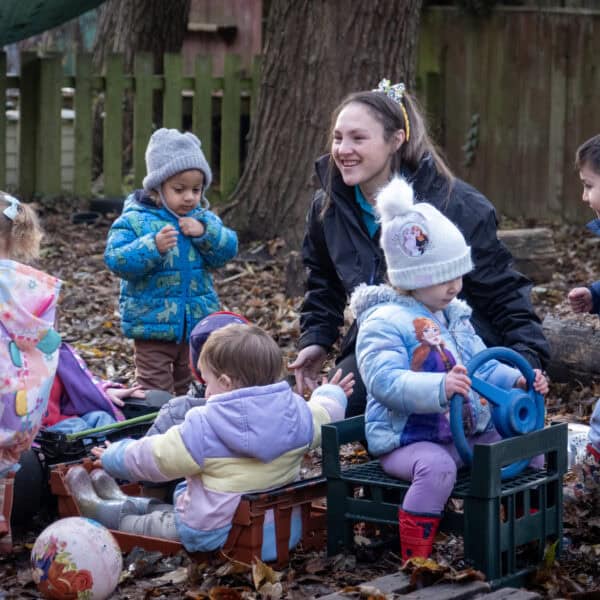
Positive risk-taking does not mean exposing children to true hazards. Rather, it means allowing them to engage in challenging play where the potential for minor, manageable mistakes exists, but the benefits of the activity far outweigh the risks. In our settings, this might look like balancing on uneven terrain, jumping from a height into a muddy puddle, or using child-sized real tools (such as small hammers or vegetable peelers) under close supervision.
These types of activities are foundational to why we are so deeply committed to outdoor learning. The natural world does not come with rubberised safety mats or perfectly even, colour-coded surfaces. It is dynamic, unpredictable, and endlessly fascinating. Experiencing the full benefits of outdoor play and exploration requires children to interact with their environment authentically. They need to feel the rough bark of a tree, gauge the depth of a trench, and understand the weight of a heavy rock. When we allow them to take these supported risks within our specialized outdoor spaces, they are actively engaging in real-world physics, mathematics, and biomechanics.
“What’s Your Plan?” – The Language of Empowerment
So, what happens when our teams replace “Be careful” with “What’s your plan?” or “Do you feel stable?”
Firstly, we immediately engage the child’s prefrontal cortex, which is the part of the brain responsible for planning, decision-making, and assessing risk. When a Thrive Childcare educator asks, “I see you’re very high up on that stump; what is your plan for getting down?”, the child is forced to stop and evaluate their situation. They must look at their environment, assess their physical capabilities, and formulate a strategy.
Other empowering phrases we use alongside this to scaffold their learning include:
- “Where will you put your foot next?”
- “Do you notice how slippery that log is today?”
- “Take your time, I am right here if you need me.”
- “Does that branch feel strong enough to hold your weight?”
This approach shifts the focus of control from the adult to the child. It tells the child that we see them, we believe in their capability, and we are here to support them, but they are ultimately in the driver’s seat. This builds an incredibly robust sense of self-efficacy. When a child successfully executes their plan, the pride radiating from their face is unmistakable. They have not just passively survived the activity; they have mastered it.
Building Deep-Rooted Resilience
We cannot talk about risk without talking about failure. Sometimes, a child’s plan will not work out perfectly. They might lose their footing and slip a few inches, their grip might fail on a branch, or their elaborately stacked tower of wooden crates might topple over. In a positive risk-taking environment like Thrive Childcare, these moments are not viewed as disasters. Instead, they are celebrated as vital learning opportunities.
If adults intervene to prevent every single scraped knee, muddy hand, or moment of frustration, we rob children of the opportunity to bounce back. Navigating these minor setbacks is precisely how we nurture resilience. When a child falls, gets back up, brushes the dirt off their knees, and tries a different approach, they are learning that failure is not final. They are learning to navigate their own emotional responses to frustration, a skill that will serve them well beyond their nursery years, into their schooling, and throughout adulthood. The modern world is an unpredictable place, and resilient children are far better equipped to handle its inevitable ups and downs.
The Role of the Thrive Educator: Supported Risk vs. Hazard
It is vital to draw a firm line between a risk and a hazard. A risk is a challenge that a child can clearly see and choose to engage with, understanding that there is an element of uncertainty. A hazard, on the other hand, is a hidden danger that a child cannot foresee or manage, such as a piece of broken glass, a toxic plant, or an unsecure gate.
Our pedagogical commitment to positive risk-taking goes hand-in-hand with Thrive Childcare’s rigorous, uncompromising approach to keeping your child safe. Our highly trained educators perform dynamic risk assessments continually throughout the day. They are constantly scanning the environment, entirely mitigating unseen hazards, and ensuring that the risks children do take are proportionate, developmentally appropriate, and carefully supported. We are always nearby, providing a watchful eye and ready to step in if a situation escalates from a healthy challenge to a genuine danger. Thrive Childcare provides the safety net while the children provide the ambition.
Fostering a Generation of Capable Explorers
Ultimately, championing positive risk-taking is about respect. At Thrive Childcare, we respect the child as a capable, competent individual who is biologically wired to learn through trial, error, and exploration. By biting our tongues, holding back our instinctive cries of “Be careful!”, and instead asking “What’s your plan?”, we give children the greatest educational gift possible: the confidence to trust themselves.
As they scale our climbing structures, balance on uneven logs, and navigate the wonderful complexities of the playground, they are not just playing. They are actively building the problem-solving skills, bodily awareness, and profound emotional resilience they need to thrive in a complex, ever-changing world.
Our Latest News


Preparing for Nursery: A Gentle Guide for Parents Starting in September
September, 3 2026 Read story
Our Nursery Brochure
We will guide you through every step of your childcare journey and help you discover everything you need to know about our nursery. Come and join our family of nurseries across the UK. If you have any questions or enquiries, please feel free to contact us.
Alternatively, why not book a personal tour of our nursery where one of our friendly team will be happy to answer any questions you may have.