
How We Spark Curiosity with Early STEM and Science Experiments
Published on May 11, 2026

Have you ever watched a toddler drop the same toy off their highchair for the tenth time, eyes wide with delight? That isn’t mischief. That’s a tiny scientist testing gravity. Long before children can spell the word “science,” they are already doing it: pouring, mixing, squashing, building, knocking down, and asking the most important question of all, “why?”
At Thrive Childcare, we believe early childhood is the perfect time to nurture this natural curiosity. That’s why STEM (Science, Technology, Engineering and Maths) sits at the heart of our early years curriculum, woven into everyday play through hands-on experiments, exploration and discovery. In this post, we’ll share how we bring STEM to life for our youngest learners, why it matters, and a few of the experiments your little one might come home talking about.
Why Early STEM Matters
It’s easy to picture STEM as something that happens in a secondary school laboratory, with goggles, beakers and lab coats. But research consistently shows that the foundations for scientific thinking are laid long before children start primary school. The early years are when the brain is at its most receptive, building neural pathways at a remarkable pace.
Introducing STEM concepts in nursery doesn’t mean teaching toddlers about photosynthesis or algebra. It means giving them the chance to:
- Ask questions and find answers through their own investigations
- Notice patterns, make predictions and test ideas
- Develop problem-solving skills and resilience when things don’t go to plan
- Build vocabulary around how the world works
- Develop confidence in their own ideas and abilities
In short, early STEM isn’t about creating tiny rocket scientists. It’s about helping children become curious, confident thinkers who love learning. Those are habits that will serve them well in every subject, and every part of life. It also pairs beautifully with the way we build a love for maths in the early years, since scientific thinking and mathematical thinking grow hand in hand.
Our Approach: Curiosity First, Always
At Thrive Childcare, we follow the child. Rather than ticking off a rigid list of experiments, our practitioners watch what the children are interested in and shape STEM learning around those sparks of curiosity. This child-led approach also means we pay close attention to each child’s individual learning style, tailoring activities so every little scientist can flourish in their own way. If a group of two-year-olds is fascinated by puddles, we don’t pull them indoors. We grab the wellies, the sticks and the magnifying glasses, and we go investigate.
Our learning environment is set up to invite exploration. You’ll find:
- Discovery tables stocked with natural materials such as pinecones, shells, leaves and stones
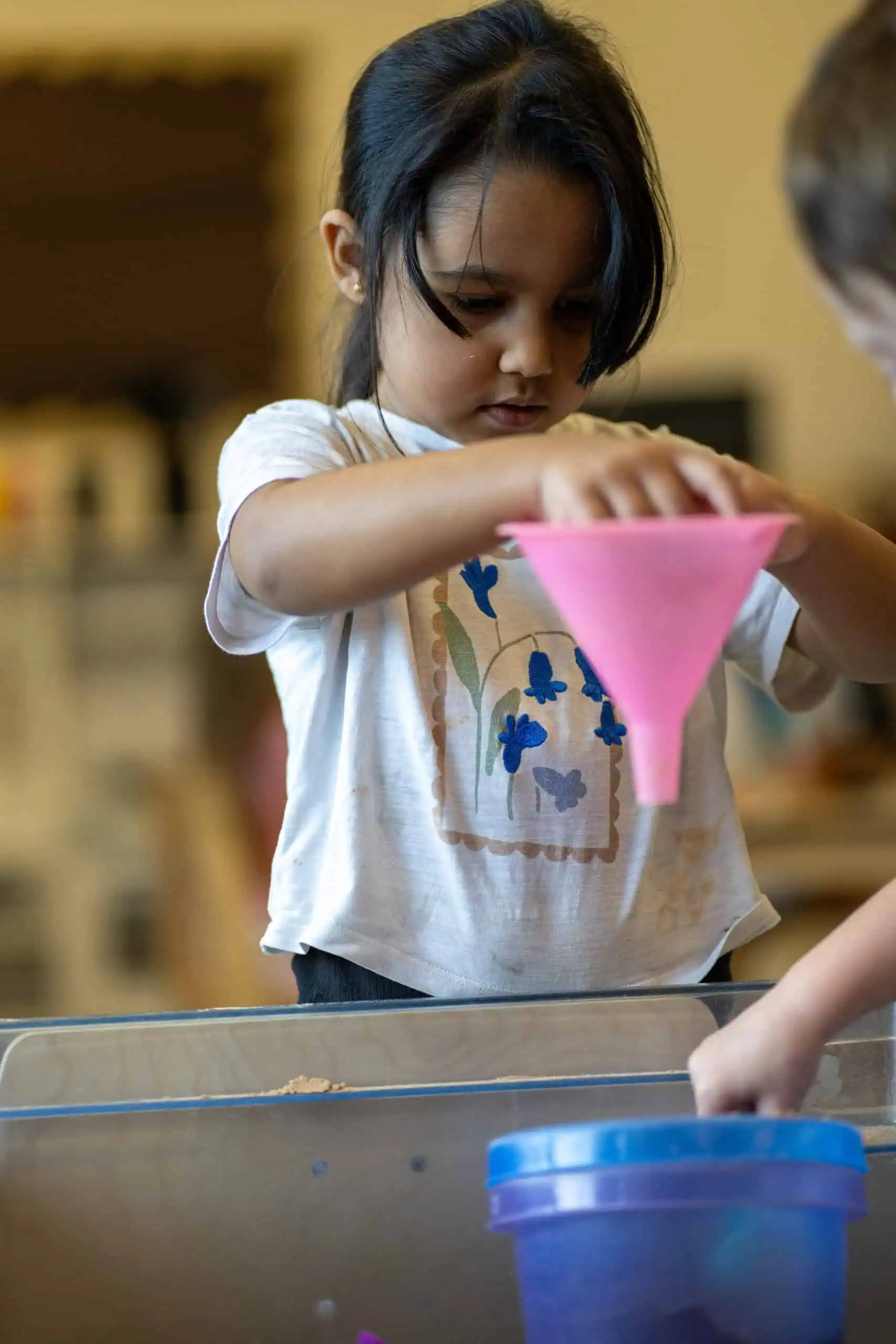
- Water and sand trays for testing volume, flow and texture, key to rich sensory play experiences
- Open-ended construction resources, from wooden blocks to loose parts and recycled cardboard
- Magnifying glasses, child-safe pipettes and measuring jugs
- Outdoor spaces designed for digging, planting, climbing and observing wildlife
Crucially, our practitioners are trained to ask the right kinds of questions. Instead of giving children the answer, we ask, “What do you think will happen?”, “Why do you think it did that?” and “What could we try next?” These open-ended prompts are gentle but powerful. They turn a simple activity into a genuine scientific investigation.
Experiments Our Little Scientists Love
Here’s a peek at some of the hands-on experiments and activities you might spot when you visit our settings. Each one is simple, safe and packed with learning.
1. The Sink or Float Challenge
A large tub of water, a tray of everyday objects (a coin, a sponge, a feather, a pebble, a plastic spoon) and a simple question: “Do you think this will sink or float?” Children make their prediction, drop it in, and watch what happens. It’s wonderfully hands-on and introduces concepts of density, weight and material properties without ever needing those big words.
2. Bicarbonate of Soda Volcanoes
A childhood classic, and for good reason. We mix bicarbonate of soda with a splash of food colouring, then let the children pour in vinegar and watch the fizzy eruption. It’s a brilliant first encounter with chemical reactions, and the giggles are guaranteed. Older preschoolers can even start to predict what will happen if they add more or less of each ingredient.
3. Building and Testing Bridges
Using wooden blocks, cardboard tubes or even sticks from the garden, we challenge our older children to build a bridge between two points. Then comes the fun part, testing it with toy cars or small weights. Which design holds the most? What happens if we make it longer? This is engineering in its purest form, and it teaches resilience too. When a bridge collapses, we cheer, talk about what we learnt, and try again.
4. Growing Cress Heads
Each child decorates an empty eggshell with a face, fills it with damp cotton wool, and sprinkles cress seeds on top. Over the following days, they water their little creation and watch the green “hair” sprout. It introduces the basic needs of living things, plus the patience and care that comes with looking after something. There’s real pride when they take their cress head home.
5. Magnet Treasure Hunts
We hide a mix of magnetic and non-magnetic objects around the room, hand out chunky child-safe magnets and let the children investigate. Why does the magnet stick to the paperclip but not the wooden peg? It’s a brilliant introduction to invisible forces and a chance to sort, classify and compare, all key early maths skills.
6. Colour-Mixing with Ice
We freeze ice cubes with a few drops of food colouring, then let the children combine them on white trays as they melt. Reds and blues swirl into purples, yellows and blues into greens. It’s magical to watch, and along the way the children meet ideas about temperature, melting, and how primary colours combine.
STEM Beyond the Experiment
Some of the most powerful STEM moments at Thrive Childcare aren’t planned at all. They happen during snack time when a child notices their banana has turned brown, or in the garden when a worm wriggles past, or at the water tray when two friends decide to build a dam together. These spontaneous discoveries are exactly why we treat play as the most important work a child can do.
Our practitioners are always ready to seize these moments. A simple, well-timed question can turn a passing observation into a rich conversation about life cycles, weather, materials or measurement. Maths is sneaked into snack time as we count grapes and share them out. Technology is explored with old keyboards and toy cameras. Engineering shows up every time a tower of blocks gets a bit taller and wobblier.
This embedded approach also flows naturally into our nature kindergarten programme, where the woodland itself becomes the classroom. Children at our nursery aren’t just doing science once a week as a special activity. They’re thinking like scientists every single day.
How You Can Spark Curiosity at Home
The brilliant thing about early STEM is that you don’t need expensive kits or a science degree. Some of the best learning happens at the kitchen sink. Here are a few easy home learning ideas to try with your little one:
- Cook together. Measuring, pouring, mixing and watching things change in the oven is full of maths and chemistry.
- Go on a nature walk. Collect leaves, count birds, look for minibeasts under stones.
- Set up bath time experiments. Plastic cups, sieves, sponges and bath toys turn the bath into a science lab.
- Ask, don’t tell. When your child asks why the sky is blue or why ice melts, resist giving the textbook answer. Instead, wonder together.
- Embrace the mess. Mud, water, paint and play dough are fantastic learning materials. The clean-up is worth it.
Most importantly, follow your child’s lead. If they’re fascinated by cars, talk about wheels, ramps and speed. If they love bugs, get a magnifying glass. Their interests are the doorway to learning.
Raising the Next Generation of Thinkers
At Thrive Childcare, we’re proud to offer a modern, well-rounded approach to early years learning that values curiosity as much as care. By weaving STEM into everyday play, we’re helping children develop skills that will serve them long after they leave us, including the ability to ask good questions, the courage to test their ideas, and the resilience to keep going when something doesn’t work the first time.
Every child who walks through our doors is a little scientist already. Our job is simply to give them the time, space and encouragement to keep wondering.
Curious to see our little scientists in action? Book a tour at your local Thrive nursery today. We’d love to show you around.
Our Latest News


Preparing for Nursery: A Gentle Guide for Parents Starting in September
September, 3 2026 Read story
Our Nursery Brochure
We will guide you through every step of your childcare journey and help you discover everything you need to know about our nursery. Come and join our family of nurseries across the UK. If you have any questions or enquiries, please feel free to contact us.
Alternatively, why not book a personal tour of our nursery where one of our friendly team will be happy to answer any questions you may have.